High Conflict: Why We Get Trapped and How We Get Out by Amanda Ripley
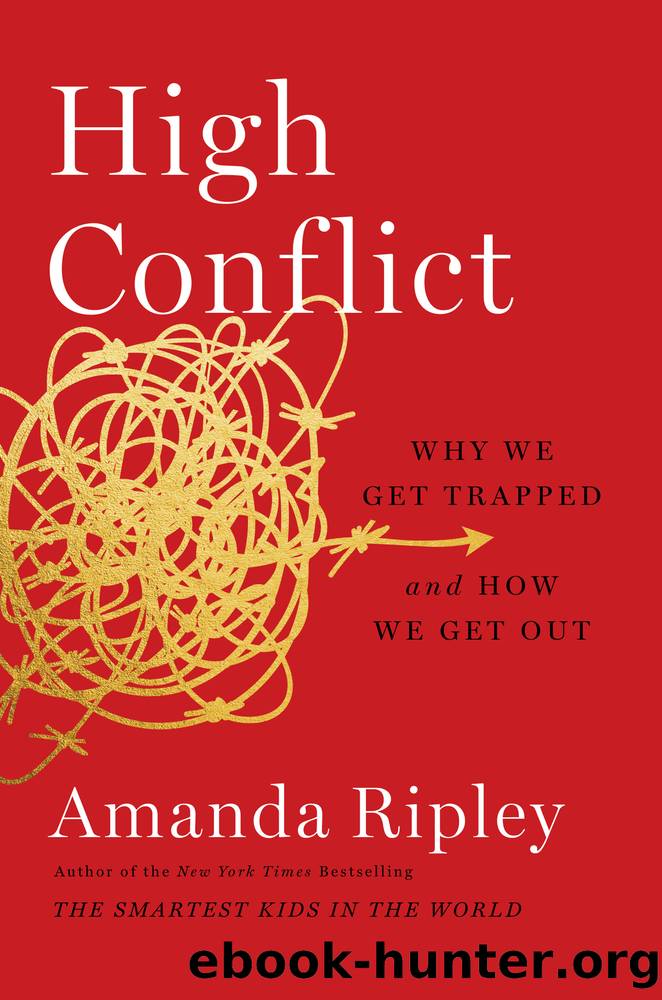
Author:Amanda Ripley [Ripley, Amanda]
Language: eng
Format: epub
ISBN: 9781982128562
Amazon: 1982128569
Publisher: Simon & Schuster
Published: 2021-04-05T23:00:00+00:00
power
Contact theory is a delicate art. Interaction with the âotherâ side is not enough. Playing basketball together does not magically lead to more understanding, all by itself.
In some cases, contact can make conflict worse. In the 1940s, a researcher named Paul H. Mussen studied 106 White, low-income New York City boys who spent a month at an integrated summer camp alongside an equal number of Black boys. After the camp ended, about a quarter of the White boys showed a significant reduction in racial prejudice. But another quarter showed a significant increase in prejudice. For those boys, contact made matters worse.
In Northern Ireland, Catholics and Protestants knew each other. Theyâd spent decades inhabiting the same small country. And yet, starting in the late 1960s, they fought one another in spasms of high conflict that lasted more than three decades. There were some 37,000 shootings and 16,000 bombings attributed to the Troubles. Why didnât contact theory work in Northern Ireland?
Contact theory seems to require a few conditions. First, everyone involved in an encounter should ideally have roughly equal status, if not in the world then at least in the room and subculture in which an encounter takes place. This was rarely the case for Catholics in Northern Ireland, who were marginalized in politics, housing, and the workforce, and it remains rare among Whites and people of color in many parts of the United States.
Second, it seems to help if some kind of respected authority supports the get-together. Maybe itâs a mosque or a church. Maybe itâs the United Nations or another countryâs leader. Whatever the case, some official show of support seems to legitimize the encounter and induce some minimal level of trust in the process.
Third, itâs ideal if people donât just talk but actually work together on some kind of common problem. This triggers our instincts for cooperation, rather than competition. It activates our desire to collaborate, rather than win. For Mark, he and the climate scientists shared the goal of saving the planet from global warming. This shared mission helped create a new, shared identity, which is much easier than trying to shed an old identity.
Finally, everyone involved should want to be there, in pursuit of some shared goal, whatever that is. This is as true in a divorce mediation as it is in a racial dialogue encounter. Motivation matters. If people want to stay in high conflict, if they want to dominate the other side or revel in contempt or righteousness, they will. And it can leave the other group vulnerable to emotional abuse or even violence. The study of the biracial camp in the 1940s found that the boys who ended up more prejudiced afterward were also the more rebellious, aggressive boys who expressed all kinds of frustrations and may have had other problems at home. The camp was, it seemed, an opportunity to unleash some of that hurt, to find a scapegoat.
Contact theory works best when everyone has enough motivation, stability, and power to take risks and withstand discomfort.
Download
This site does not store any files on its server. We only index and link to content provided by other sites. Please contact the content providers to delete copyright contents if any and email us, we'll remove relevant links or contents immediately.
Unwinding Anxiety by Judson Brewer(73038)
The Art of Coaching by Elena Aguilar(53249)
The Fast Metabolism Diet Cookbook by Haylie Pomroy(21143)
Rewire Your Anxious Brain by Catherine M. Pittman(18654)
Healthy Aging For Dummies by Brent Agin & Sharon Perkins RN(17045)
Talking to Strangers by Malcolm Gladwell(13370)
The Art of Thinking Clearly by Rolf Dobelli(10487)
Mindhunter: Inside the FBI's Elite Serial Crime Unit by John E. Douglas & Mark Olshaker(9339)
Crazy Rich Asians by Kevin Kwan(9290)
The Compound Effect by Darren Hardy(8964)
Tools of Titans by Timothy Ferriss(8393)
Periodization Training for Sports by Tudor Bompa(8271)
Becoming Supernatural by Dr. Joe Dispenza(8214)
Wonder by R. J. Palacio(8108)
Crystal Healing for Women by Mariah K. Lyons(7930)
Bodyweight Strength Training by Jay Cardiello(7917)
Change Your Questions, Change Your Life by Marilee Adams(7780)
Therapeutic Modalities for Musculoskeletal Injuries, 4E by Craig R. Denegar & Ethan Saliba & Susan Saliba(7722)
Nudge - Improving Decisions about Health, Wealth, and Happiness by Thaler Sunstein(7706)
